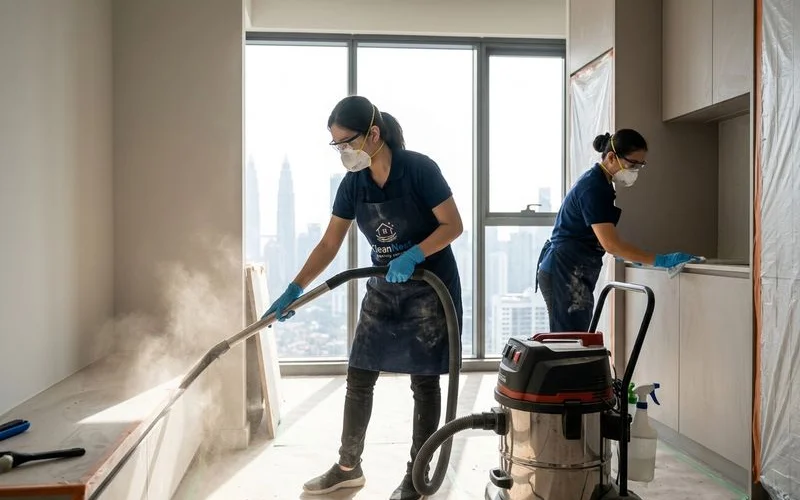

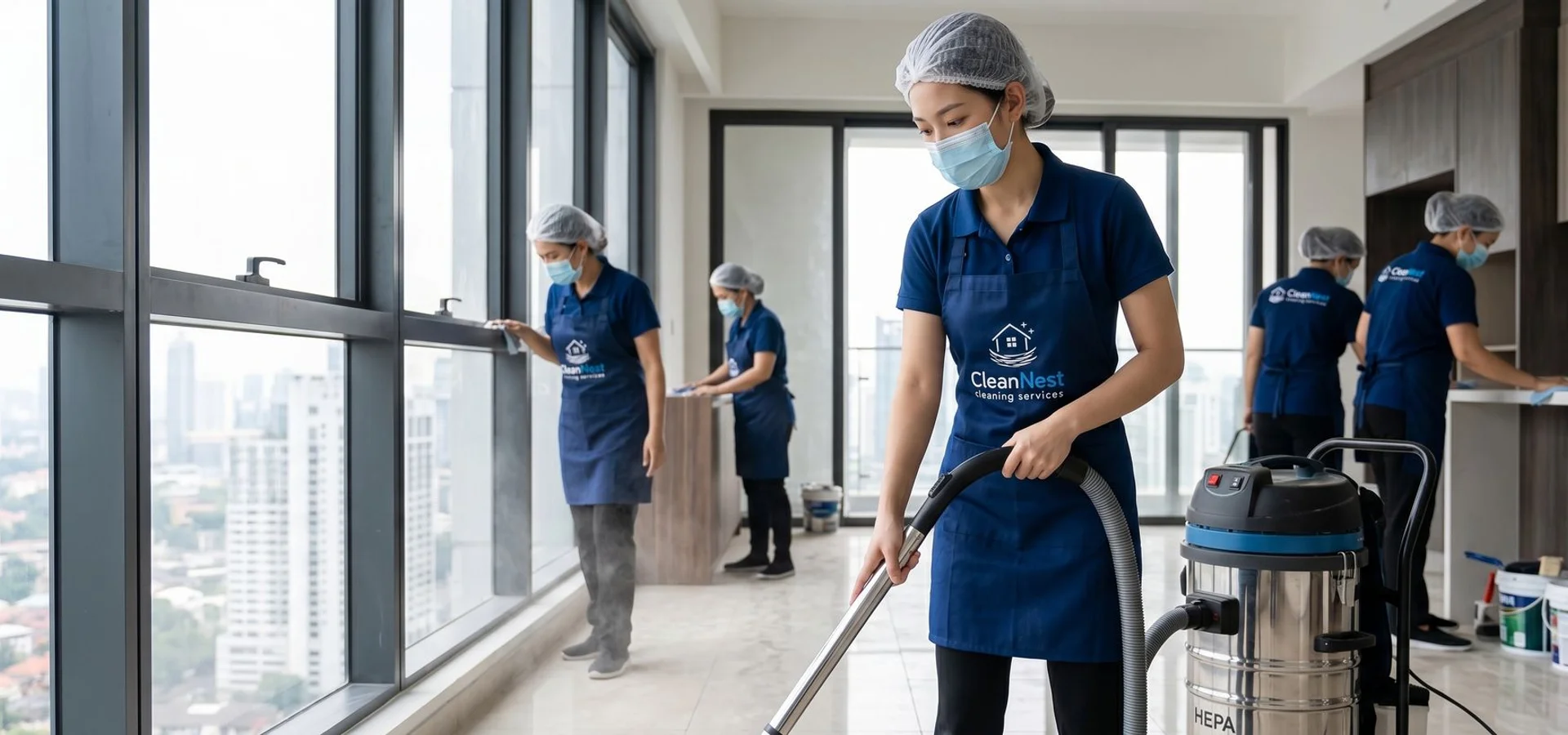
Clean Nest is a professional cleaning company based in Kepong, Kuala Lumpur, with 250+ completed jobs and a 5.0-star Google rating across 250+ reviews. Our all-female, background-checked team specialises in removing fine construction dust, formaldehyde, and grout haze left behind after renovation work across the Klang Valley.
Have you just finished a major home makeover? That frustrating layer of white dust, lingering formaldehyde, and stubborn grout haze are exactly what our trained crew handles every day.
We are going to walk you through the exact steps for managing this post-renovation cleaning safely so you can settle in comfortably.
Why Contractor Cleanup Isn’t Enough
Construction leaves behind a specific set of contaminants that routine wiping simply cannot fix. Walking into a freshly renovated KL home reveals several hidden messes.
We see these specific issues on almost every job site across the city. These problems include:
- Fine silica and cement dust: This settles on every surface, inside cabinets, and inside air vents.
- Formaldehyde and VOCs: These gases emit from new engineered wood, adhesives, and popular paints like Nippon Paint.
- Grout haze: Freshly laid floor tiles often have a milky film that is almost invisible until light hits it sideways.
- Paint splatter and adhesive residue: You will find these stubborn marks along edges, corners, switches, and window frames.
Off-the-shelf household sprays often make these problems much worse. Adding water to fine cement dust actually creates a concrete-like paste that ruins expensive finishes.
Our technicians work systematically across every surface, vent, and behind-appliance gap with specialized tools. This approach uses HEPA-grade vacuums and KKM-approved products to ensure the safest environment.
Families with newborns or asthma sufferers especially need this level of care before moving in. Let’s look at a quick comparison to see the real differences.
| Feature | Routine Deep Clean | Post-Renovation Clean |
|---|---|---|
| Equipment Used | Standard household vacuums | Industrial H13 HEPA vacuums |
| Particle Capture | Large dust and pet hair | 0.3-micron PM2.5 silica dust |
| Chemicals | Generic supermarket sprays | KKM-approved residue removers |
| Primary Goal | Surface-level neatness | Complete contaminant extraction |
Health Risks of Construction Dust and Formaldehyde
Post-renovation contaminants create real health concerns for your family. Fine silica dust from cut concrete is smaller than 2.5 microns, known as PM2.5.
Our research shows these tiny particles easily bypass your throat and settle deep into your lungs. This invisible threat can stay airborne for weeks after the contractors pack up their tools.
“Opening your windows is helpful, but physical extraction is the only way to completely remove PM2.5 silica dust that has already settled inside your new cabinets.”
We also monitor the dangerous off-gassing from several common renovation materials:
- Engineered Wood and MDF: These materials release formaldehyde as the glue dries.
- Fresh Paint and Varnishes: Popular wall coatings emit VOCs into the indoor air.
- New Carpets and Vinyl: Synthetic floorings often off-gas strong chemical odors.
As of 2026, the Department of Occupational Safety and Health (DOSH) Malaysia sets the safe indoor limit for formaldehyde at 0.1 ppm. You will usually see these chemical emissions peak during the first two to four weeks after installation.
For households with toddlers, asthma sufferers, or respiratory sensitivity, proper extraction is essential before move-in. Air purifiers help filter floating particles, but settled dust requires physical removal.
The Clean Nest crew strictly uses KKM-approved cleaning agents to ensure no harsh chemicals remain behind. New parents should never have to worry about toxic residues lingering on the floors where their children play.
What Our After-Renovation Service Covers
Across hundreds of Klang Valley jobs - from Mont Kiara condos to Kepong terrace houses and Cheras apartments - this service covers a massive amount of detail. The standard scope requires specialized techniques to handle heavy debris safely.
We provide a comprehensive checklist to guarantee nothing gets missed. These standard deliverables include:
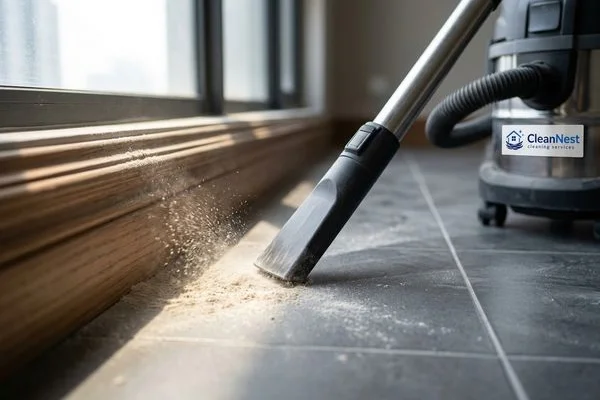
- HEPA vacuum extraction: Industrial H13 filters pull 0.3-micron fine dust from every reachable surface, including floors, vents, cabinet interiors, behind appliances, and ceiling fans.
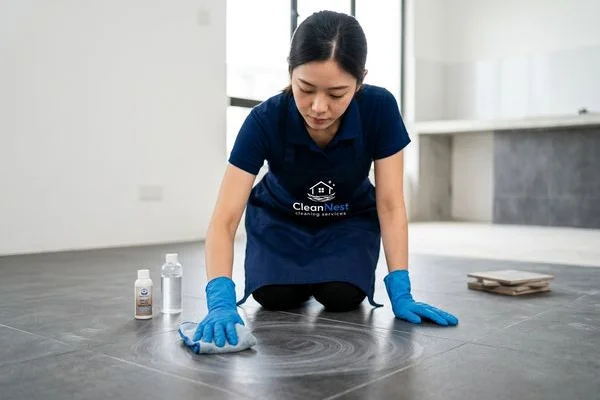
- Grout haze and tile film removal: This critical step restores freshly laid tiles, and skipping it is exactly why “newly tiled” floors often look hazy for months.
- Paint splatter and adhesive residue removal: The technicians safely lift tile-cutting marks and glue from windows, frames, switches, and skirting boards.
- Inside-cabinet and inside-drawer cleaning: This pre-occupancy detail ensures you never move your clean dishes and clothes onto a hidden layer of construction dust.
- Full bathroom sanitisation: The team thoroughly sanitizes the space post-tile, post-grout, and post-silicone installation.
- Final surface wipe: Every wall, door, switch, and visible surface gets a detailed pass to remove lingering particles.
Equipment matters heavily in this phase of the process.
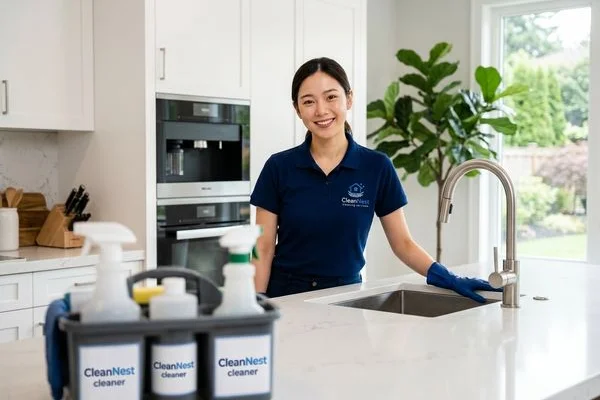
Clean Nest technicians bring commercial-grade PPE and KKM-approved products formulated specifically for new-build environments.
A standard household mop and a generic disinfectant simply spread the mess around. Proper tools ensure your new home is truly safe.
Best Time to Book Before Your KL Move-In
The right timing is always “before move-in, after all wet trades are dry.” Booking the cleaners too early means the contractors might create new dust later.
Our experts recommend following this specific timeline for the best results:
- Wait 2 to 5 days after the last paint or grout job: This allows popular finishes like Nippon Paint and wet epoxy grout to cure fully.
- Schedule before furniture arrives: Cleaning around heavy new furniture in a condo or semi-detached home is much harder, slower, and more expensive.
- Coordinate with your contractor or interior designer: This ensures you avoid getting double-booked with final appliance installers.
We strongly advise securing your date early to avoid scheduling conflicts. Property managers and real estate agents often book us to prepare units for new tenants after a renovation handover. If you have already moved your belongings inside, the clean is still entirely possible.
You will just receive a slightly higher quote because the team must carefully work around your personal items.
How Post-Reno Cleaning Is Priced
Post-renovation cleaning is always priced by floor area and debris volume, rather than by the hour. Hourly-rate models systematically under-quote this intensive work.
We know that fine-dust extraction scales directly with surface area instead of time. A 1,000 square foot condominium and a 500 square foot apartment have vastly different scopes compared to a landed bungalow or a commercial office unit after a fit-out.
Both units might technically take the same nominal number of hours, but the physical labor differs greatly. Our 2026 industry analysis shows a proper deep clean for a 1,000 square foot unit often requires up to 16 man-hours of continuous effort.
Booking early ensures you secure your preferred date without stress.
“App-based cleaners charging by the hour often run out of time before they even finish extracting the ceiling dust. Always book a fixed-price package based on your square footage.”
For routine post-renovation bookings across Desa ParkCity, Bangsar, Sri Petaling, and the wider KL area, a lead time of three to seven days works perfectly. We suggest planning at least a week or more ahead during peak handover seasons, such as the year-end or pre-Chinese New Year periods.
Getting a fast, accurate price is very simple.
WhatsApp us photos and floor area, and get your quote returned within the hour during operating times.